Parasitic Nematodes & One Health
Parasitic roundworms cause enormous suffering —
in humans, in crops, and in livestock. We use our knowledge of nematode ecology, evolution, and development to look for new ways to fight them.
in humans, in crops, and in livestock. We use our knowledge of nematode ecology, evolution, and development to look for new ways to fight them.
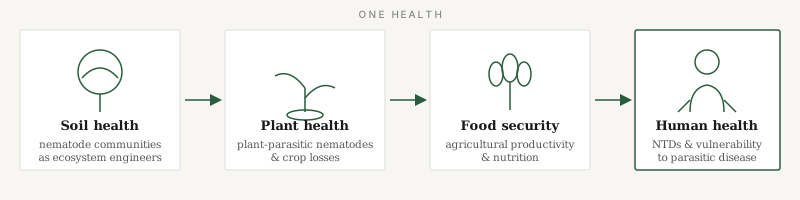
One Health — one phylum, many hosts
Nematodes are everywhere. Most of them are free-living in soil, doing the ecological work we describe on our biodiversity page. But a substantial fraction of nematode species have evolved to parasitise animals, plants, and insects — and several of these cause profound harm to human health and agricultural systems globally.
The One Health framework recognises that human health, animal health, and ecosystem health are connected. For nematodes, this connection is direct: degraded soil ecosystems harbour different nematode communities, including altered proportions of plant-parasitic species that reduce crop yields and food security. Undernutrition and poverty — both driven in part by agricultural losses to plant parasites — increase vulnerability to the human-parasitic nematodes causing neglected tropical diseases. The biology links these problems too: the developmental and molecular mechanisms we study in free-living nematodes are conserved across parasitic lineages, meaning insights from one system inform the others.
The One Health framework recognises that human health, animal health, and ecosystem health are connected. For nematodes, this connection is direct: degraded soil ecosystems harbour different nematode communities, including altered proportions of plant-parasitic species that reduce crop yields and food security. Undernutrition and poverty — both driven in part by agricultural losses to plant parasites — increase vulnerability to the human-parasitic nematodes causing neglected tropical diseases. The biology links these problems too: the developmental and molecular mechanisms we study in free-living nematodes are conserved across parasitic lineages, meaning insights from one system inform the others.
Human NTDs
Roundworms are the cause of many neglected tropical diseases (NTDs), collectively affecting more than a billion people — disproportionately in low-income countries where access to treatment is limited. Soil-transmitted helminths (hookworm, Ascaris, whipworm), filarial nematodes causing lymphatic filariasis and river blindness, and other parasitic roundworms remain major causes of chronic disability and developmental harm in children worldwide.
Current control efforts rely on a small number of drugs, and the emergence of resistance in both human and veterinary nematode populations is a growing concern. Finding new drug targets is urgent.
Our approach draws on our EvoDevo research: nematodes are locked into a conserved adult body plan despite huge molecular and developmental diversity, which suggests there are deeply conserved developmental constraints that could serve as drug targets across many parasitic species simultaneously. We combine network analysis of developmental gene regulatory networks with computational identification of conserved pathways to find targets that are essential across parasitic lineages but absent or divergent in the human host.
This project is run by Austine, who is a DAAD funded PhD-researcher in the lab.
Current control efforts rely on a small number of drugs, and the emergence of resistance in both human and veterinary nematode populations is a growing concern. Finding new drug targets is urgent.
Our approach draws on our EvoDevo research: nematodes are locked into a conserved adult body plan despite huge molecular and developmental diversity, which suggests there are deeply conserved developmental constraints that could serve as drug targets across many parasitic species simultaneously. We combine network analysis of developmental gene regulatory networks with computational identification of conserved pathways to find targets that are essential across parasitic lineages but absent or divergent in the human host.
This project is run by Austine, who is a DAAD funded PhD-researcher in the lab.
Plant-parasitic nematodes
Plant-parasitic nematodes cause an estimated $80–120 billion in crop losses globally each year — comparable in scale to losses from fungal diseases, but far less recognised outside specialist circles. Species like root-knot nematodes (Meloidogyne spp.), cyst nematodes (Heterodera, Globodera), and lesion nematodes (Pratylenchus spp.) infect the roots of almost every crop species, reducing yields and making plants more vulnerable to other pathogens.
We work on plant-parasitic nematodes through collaborations in Thailand, Vietnam, and Uganda, with a focus on two complementary strategies:
Rapid molecular diagnostics. Together with colleagues in Thailand we have developed LAMP (Loop-Mediated Isothermal Amplification) assays for rapid, field-deployable detection of plant-parasitic nematodes in agricultural commodities — an approach that works without expensive laboratory infrastructure and can be deployed at ports of entry or directly in the field. This work is directly relevant to biosecurity and trade, as plant-parasitic nematodes are a major pathway for invasive species spread through infected plant material. We are now extending this to use field-based genome sequencing methods developed in our biodiversity research.
Plant extracts as biocontrol agents. In collaboration with partners in Uganda and Vietnam we are exploring plant-derived compounds with nematicidal activity as alternatives or complements to synthetic chemical nematicides. This work connects traditional ecological knowledge — local plants used empirically against soil pests — with modern genomic and biochemical tools to understand mechanisms of action and identify which compounds are most promising for development.
We work on plant-parasitic nematodes through collaborations in Thailand, Vietnam, and Uganda, with a focus on two complementary strategies:
Rapid molecular diagnostics. Together with colleagues in Thailand we have developed LAMP (Loop-Mediated Isothermal Amplification) assays for rapid, field-deployable detection of plant-parasitic nematodes in agricultural commodities — an approach that works without expensive laboratory infrastructure and can be deployed at ports of entry or directly in the field. This work is directly relevant to biosecurity and trade, as plant-parasitic nematodes are a major pathway for invasive species spread through infected plant material. We are now extending this to use field-based genome sequencing methods developed in our biodiversity research.
Plant extracts as biocontrol agents. In collaboration with partners in Uganda and Vietnam we are exploring plant-derived compounds with nematicidal activity as alternatives or complements to synthetic chemical nematicides. This work connects traditional ecological knowledge — local plants used empirically against soil pests — with modern genomic and biochemical tools to understand mechanisms of action and identify which compounds are most promising for development.
The shared biology
What connects our work on human NTDs and plant parasites is the same thing that connects it to our free-living nematode research: we study the biology of the worm deeply, across the phylogenetic tree, and use that knowledge to find leverage points. The gene regulatory networks controlling nematode development are conserved across parasitic and free-living lineages. The cryptobiosis mechanisms we study in soil nematodes — survival without water or oxygen — are related to the mechanisms parasitic nematodes use to survive as infective stages outside a host. The genomic tools we develop for biodiversity work are the same ones we use to characterise parasitic species and identify drug targets.
Collaborators
Thailand — Collaboration with Prof. Buncha Chinnasri and colleagues (Kasetsart University, Bangkok), including Dr Beesa and Dr Suwanngam (now in Japan): LAMP diagnostics for plant-parasitic nematodes in agricultural export commodities.
Vietnam — Dr Thi Anh Duong Nguyen (Vietnam Academy of Science and Technology, Hanoi): Parasite detection and nematode diversity in coffee plantations.
Uganda — Justine Nakintu and visiting student Godfrey Sserwadda (Mbarara University of Science and Technology): Parasite detection, plant-derived biocontrol compounds and traditional knowledge on nematode pest management.
Oxford — Dr. Joseph Kirangwa (University of Oxford): Evolutionary genomics of parasitic nematodes.
Vietnam — Dr Thi Anh Duong Nguyen (Vietnam Academy of Science and Technology, Hanoi): Parasite detection and nematode diversity in coffee plantations.
Uganda — Justine Nakintu and visiting student Godfrey Sserwadda (Mbarara University of Science and Technology): Parasite detection, plant-derived biocontrol compounds and traditional knowledge on nematode pest management.
Oxford — Dr. Joseph Kirangwa (University of Oxford): Evolutionary genomics of parasitic nematodes.
Bluesky: @worm-lab.bsky.social
Instagram: @worm.lab
Instagram: @worm.lab
Zülpicher Str. 47b, 50674 Köln,
Deutschland
Deutschland
Pictures are own work with additional material from: Schulze and Schierenberg 2008 / wikipedia.org (under CC BY 2.0, CC BY-SA 4.0 licences) / D. Sethi (network) / E. Schierenberg (Bauplan).
